
Miles in the '60s
A fresh look at Miles Davis' best decade.

Hello! Thank you to everyone who shared, commented on, or otherwise engaged with Miles Davis at Lennie’s on the Turnpike earlier this week. And extra-special thanks if you also support The Gig as a paid subscriber. I’ve been publishing these outside the paywall, because I want everyone to have access if they want it. But if you value the writing that appears here and haven’t yet upgraded to a paid subcription, please consider it now. There’s no better way to keep The Gig thriving.
Now, on to my next piece ahead of Miles 100. Where the Lennie’s post focused on a single point in time (give or take), this one attempts something like a survey, taking in what I consider to be the artist’s best decade.
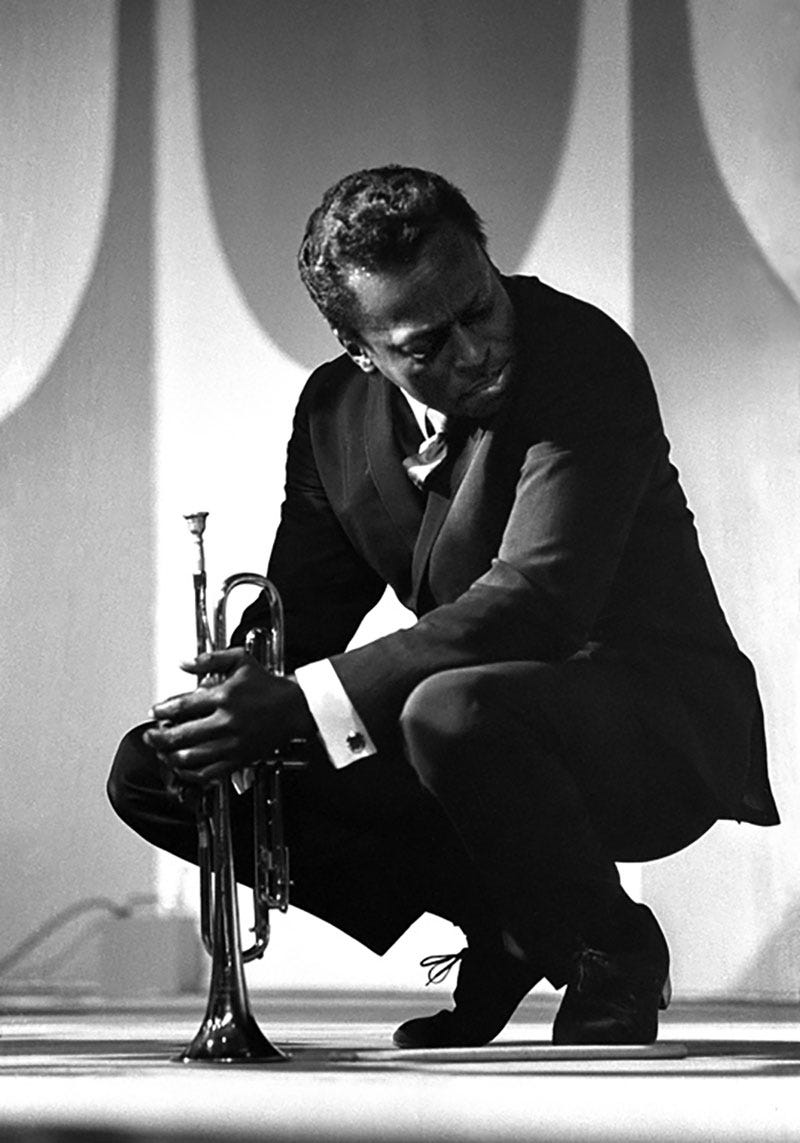
Earlier today I heard something on a Miles Davis recording that made me laugh out loud.
OK, maybe it was just an appreciative low chuckle. But laughter of any kind is a rare-enough response to the art of our Prince of Darkness, so I’d say it counts.
What was I listening to? The Complete Live at the Plugged Nickel 1965, in the 10-LP edition reissued for Davis’ centennial, with sharp new liner notes by my fellow jazz Substacker Syd Schwartz. This set is a landmark of small-group modern jazz, and I’ve spent hundreds of hours with it since I acquired my previous 8-CD box in 1995.
The track in question was a version of “Walkin’” from the first set on December 23 — find it on Disc 5 of the CD box, or LP 6 of the vinyl box (which is how I heard it). Set first at a pneumatic tempo, around 320 bpm, it downshifts to a swinging half-time before lurching back into overdrive. Miles’ bravura trumpet solo conveys dartlike precision and a matador’s command, with the focused determination not to lose his balance despite a rhythm section operating like a Tilt-a-Whirl.
What was so funny? Cue up the track to 4:40, just after the end of the trumpet solo. Herbie Hancock fills space with one of his patented chordal elaborations, a chromatic stairlift that sets up Wayne Shorter’s entrance on tenor saxophone. Then in comes Shorter — entering with a quotation I’d somehow forgotten about. It’s the core melodic motif from “People,” which Barbra Streisand had just floated to the top of the Billboard 200 the previous year: People… people who need people. LOL. And it’s even not the end of the quote: Wayne circles back to Streisand’s misty-eyed anthem later in his solo, though he closes with a more familiar citation, his own “Pinocchio.”
Miles Davis was such a magnetic and extraordinary figure that it can be tempting, especially on an occasion like his centennial, to hail him in isolation. Jazz doesn’t work that way, and neither did he. He was, forgive me, people who need people.1 This was true throughout his career, but I think it comes into focus especially during the 1960s, a decade bracketed by two pivotal landmarks, Kind of Blue and Bitches Brew. Each of those albums is unimaginable without the personnel Miles assembled, and the span between them is a testament to how much he relied on the spark of rapport. More on that in just a moment.
BBC Radio 3: Composer of the Week
As part of the centennial celebration, I’ll be on the BBC 3’s Composer of the Week programme talking Miles Davis 100, next Monday through Friday at 16:00 London time (noon EDT). If you’re in the UK, please tune in! Each weekday covers an era in Davis’ career, with a well-curated selection of music surrounded by commentary.
Birth of the Cool (Monday)
Kind of Blue (Tuesday)
Second Great Quintet (Wednesday)
On the Corner (Thursday)
Rebirth (Friday)
I had a terrific time conversing with host Kate Molleson, the esteemed radio presenter, music journalist and author. I think folks outside the UK can listen live — but only if you have a BBC membership and are logged into the app.
Miles in MOJO
Speaking of Miles Davis centennial tributes in British media, you may already be aware that the April issue of MOJO features a split cover story, celebrating both Miles at 100 and Punk at 50. (The magazine comes with a CD compilation titled Miles: The Classic Sounds Of Miles Davis & Friends.) I picked up my copy of this issue recently at a Barnes & Noble, so check your local newsstand.
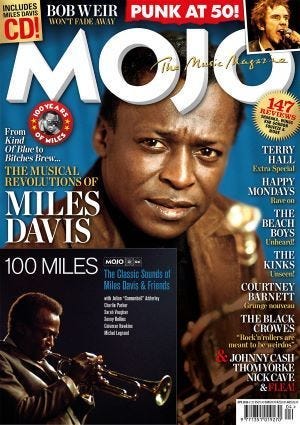
The magazine did a bang-up job with this tribute, and I’m not just saying it as a contributor. Shout out to senior editor Danny Eccleston, who took the lead in pulling the package together. His idea was to divide Davis’ career by decade and assign each one to a writer. Grayson Haver Currin handled the early years, up through The Birth of the Cool. Chris Ingham got the 1950s, including Kind of Blue. Andrew Male took the ‘70s, post-Bitches, including the fallow years; and the venerable David Fricke closed things out with the ‘80s, Miles’ comeback decade.
You may have noticed that I just skipped over the ‘60s. This is the decade I wrote about, and I feel fortunate to have been granted my first choice. It was initially a bit intimidating to consider how much I wanted to say, and how succinct I’d have to be. Remember, too, that MOJO is a mainstream publication aimed at a different audience than the one served by DownBeat or Jazzwise. So my challenge was to survey an intensely productive and mercurial decade in Davis’ career, drawing a compelling narrative and making a critical case while avoiding most musical jargon. Without knowing exactly what my colleagues would write, I also tried to structure my essay as a bridge between the ‘50s and the ‘70s. I think I pulled it off.
MOJO typically maintains a three-month window of exclusivity before an author can repost an article. They granted special permission in this case, in order to hit the big 100th. Again, I encourage you to purchase the issue and support quality music journalism. In the meantime, please enjoy my contribution below.
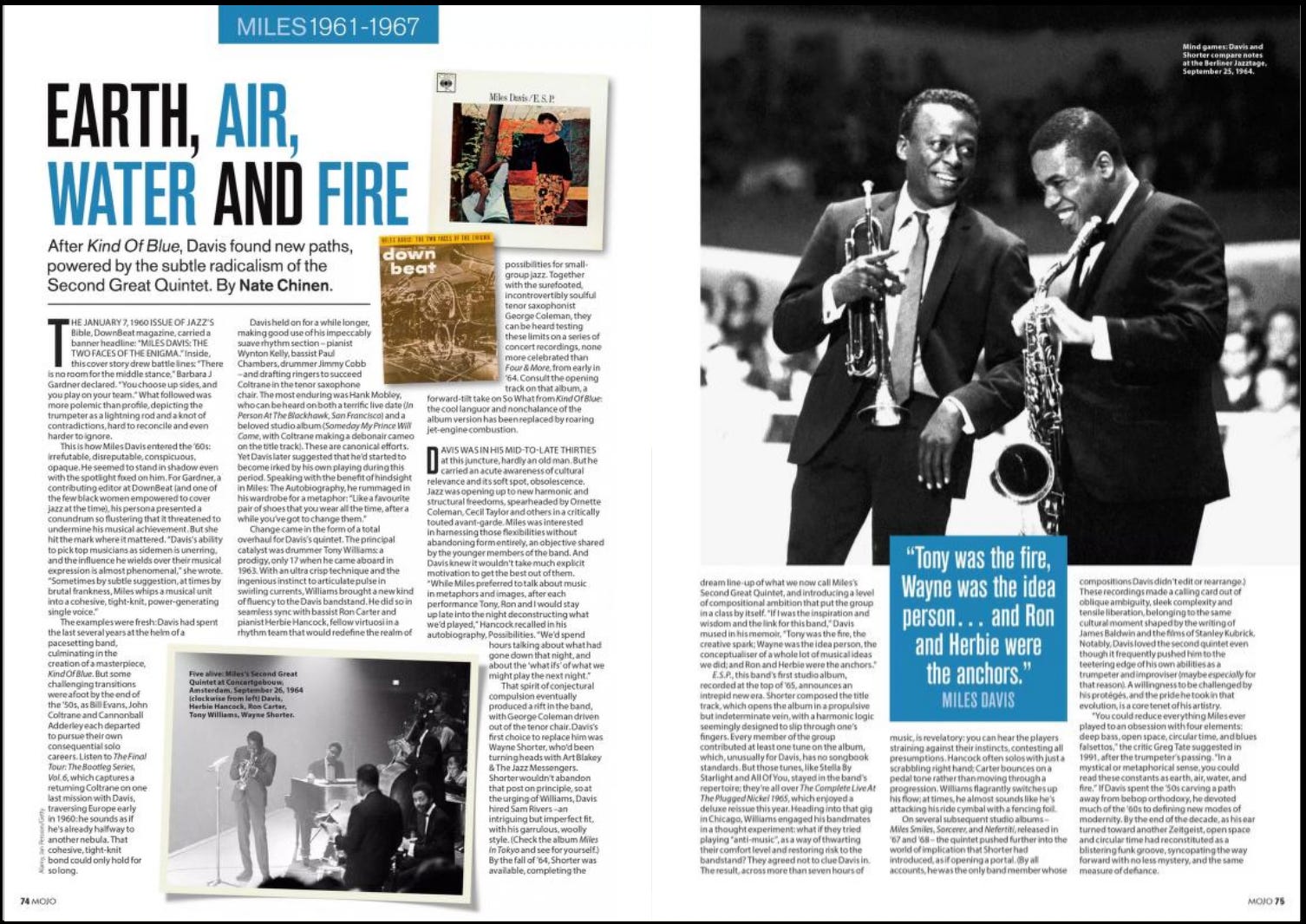
Earth, Air, Water and Fire
After Kind of Blue, Davis found new paths, powered by the suble radicalism of the Second Great Quintet.
By Nate Chinen
The Jan. 7, 1960 issue of jazz’s Bible, DownBeat magazine, carried a banner headline: MILES DAVIS: THE TWO FACES OF THE ENIGMA. Inside, this cover story drew battle lines: “There is no room for the middle stance,” Barbara J. Gardner declared. “You choose up sides, and you play on your team.” What followed was more polemic than profile, depicting the trumpeter as a lightning rod and a knot of contradictions, hard to reconcile and even harder to ignore.
This is how Miles Davis entered the ‘60s: irrefutable, disreputable, conspicuous, opaque. He seemed to stand in shadow even with the spotlight fixed on him. For Gardner, a contributing editor at DownBeat (and one of the few Black women empowered to cover jazz at the time), his persona presented a conundrum so flustering that it threatened to undermine his musical achievement. But she hit the mark where it mattered. “Davis’ ability to pick top musicians as sidemen is unerring, and the influence he wields over their musical expression is almost phenomenal,” she wrote. “Sometimes by subtle suggestion, at times by brutal frankness, Miles whips a musical unit into a cohesive, tight-knit, power-generating single voice.”
The examples were fresh: Davis had spent the last several years at the helm of a pacesetting band, culminating in the creation of a masterpiece, Kind of Blue. But some challenging transitions were afoot by the end of the ‘50s, as Bill Evans, John Coltrane and Cannonball Adderley each departed to pursue their own consequential solo careers. Listen to The Final Tour: The Bootleg Series, Vol. 6, which captures a returning Coltrane on one last mission with Miles, traversing Europe early in 1960: he sounds as if he’s already halfway to another nebula. That cohesive, tight-knit bond could only hold for so long.
Miles held on for a while longer, making good use of his impeccably suave rhythm section — pianist Wynton Kelly, bassist Paul Chambers, drummer Jimmy Cobb — and drafting ringers to succeed Coltrane in the tenor saxophone chair. The most enduring was Hank Mobley, who can be heard on both a terrific live date (In Person at the Blackhawk, San Francisco) and a beloved studio album (Someday My Prince Will Come, with Coltrane making a debonair cameo on the title track). These are canonical efforts. Yet Davis later suggested that he’d started to become irked by his own playing during this period. Speaking with the benefit of hindsight in Miles: The Autobiography, he rummaged in his wardrobe for a metaphor: “Like a favorite pair of shoes that you wear all the time, after a while you’ve got to change them.”
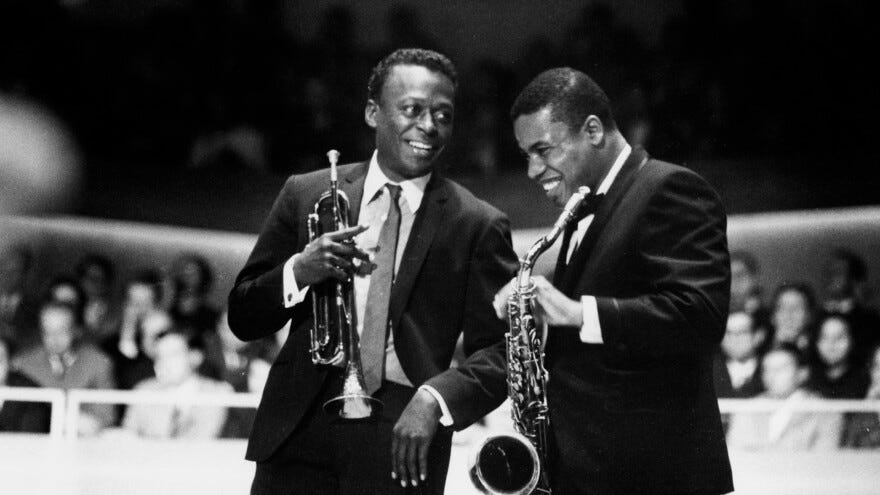
Change came in the form of a total overhaul for Davis’ quintet. The principal catalyst was drummer Tony Williams: a prodigy, only 17 when he came aboard in 1963. With an ultracrisp technique and the ingenious instinct to articulate pulse in swirling currents, Williams brought a new kind of fluency to Davis’ bandstand. He did so in seamless sync with bassist Ron Carter and pianist Herbie Hancock, fellow virtuosi in a rhythm team that would redefine the realm of possibilities for small-group jazz. Together with the surefooted, incontrovertibly soulful tenor saxophonist George Coleman, they can be heard testing these limits on a series of concert recordings, none more celebrated than Four & More, from early in ‘64. Consult the opening track on that album, a forward-tilt take on “So What” from Kind of Blue: the cool languour and nonchalance of the album version has been replaced by roaring jet-engine combustion.
Davis was in his mid-to-late 30s at this juncture, hardly an old man. But he carried an acute awareness of cultural relevance and its soft spot, obsolescence. Jazz was opening up to new harmonic and structural freedoms, spearheaded by Ornette Coleman, Cecil Taylor and others in a critically touted avant-garde. Miles was interested in harnessing those flexibilities without abandoning form entirely, an objective shared by the younger members of the band. And Davis knew it wouldn’t take much explicit motivation to get the best out of them. “While Miles preferred to talk about music in metaphors and images, after each performance Tony, Ron and I would stay up late into the night deconstructing what we’d played,” Hancock recalled in his autobiography, Possibilities. “We’d spend hours talking about what had gone down that night, and about the ‘what ifs’ of what we might play the next night.”
That spirit of conjectural compulsion eventually produced a rift in the band, with Coleman driven out of the tenor chair. Davis’ first choice to replace him was Wayne Shorter, who’d been turning heads with Art Blakey & the Jazz Messengers. Shorter wouldn’t abandon that post on principle, so at the urging of Williams, Davis hired Sam Rivers — an intriguing but imperfect fit, with his garrulous, woolly style. (Check the album Miles in Tokyo and see for yourself.) By the fall of ‘64, Shorter was available, completing the dream lineup of what we now call Miles’ second great quintet, and introducing a level of compositional ambition that put the group in a class by itself. “If I was the inspiration and wisdom and the link for this band,” David mused in his memoir, “Tony was the fire, the creative spark; Wayne was the idea person, the conceptualizer of a whole lot of musical ideas we did; and Ron and Herbie were the anchors.”
E.S.P., this band’s first studio album, recorded at the top of ‘65, announces an intrepid new era. Shorter composed the title track, which opens the album in a propulsive but indeterminate vein, with a harmonic logic seemingly designed to slip through one’s fingers. Every member of the group contributed at least one tune on the album, which, unusually for Davis, has no songbook standards. But those tunes, like “Stella By Starlight” and “All of Me,” stayed in the band’s repertoire; they’re all over The Complete Live at the Plugged Nickel 1965, which enjoyed a deluxe reissue this year. Heading into that gig in Chicago, Williams engaged his band mates in a thought experiment: what if they tried playing “anti-music,” as a way of thwarting their comfort level and restoring risk to the bandstand? They agreed not to clue Davis in. The result, across more than seven hours of music, is revelatory: you can hear the players straining against their instincts, contesting all presumptions. Hancock often solos with just a scrabbling right hand; Carter bounces on a pedal tone rather than moving through a progression. Williams flagrantly switches up his flow; at times, he almost sounds like he’s attacking his ride cymbal with a fencing foil.
On several subsequent studio albums — Miles Smiles, Sorcerer, and Nefertiti, released in ‘67 and ‘68 — the quintet pushed further into the world of implication that Shorter had introduced, as if opening a portal. (By all accounts, he was the only band member whose compositions Miles didn’t edit or rearrange.) These recordings made a calling card out of oblique ambiguity, sleek complexity and tensile liberation, belonging to the same cultural moment shaped by the writing of James Baldwin and the films of Stanley Kubrick. Notably, Miles loved the second quintet even though it frequently pushed him to the teetering edge of his own abilities as a trumpeter and improviser (maybe especially for that reason). His willingness to be challenged by his protégés, and the pride he took in that evolution, is a core tenet of his artistry.
“You could reduce everything Miles ever played to an obsession with four elements: deep bass, open space, circular time, and blues falsettos,” the critic Greg Tate suggested in 1991, after the trumpeter’s passing. “In a mystical or metaphorical sense, you could read these constants as earth, air, water, and fire.” If Miles spent the ‘50s carving a path away from bebop orthodoxy, he devoted much of the ‘60s to defining new modes of modernity. By the end of the decade, as his ear turned toward another zeitgeist, open space and circular time had reconstituted as a blistering funk groove, syncopating the way forward with no less mystery, and the same measure of defiance.
The Theme (Incomplete)
You may have noticed that the only two critics I cite in the MOJO essay were Barbara J. Gardner and Greg Tate. I was conscious about this, knowing that all of the other contributors to the magazine’s Miles package were white men. Gardner, better known as Barbara Gardner Proctor, went on to a pioneering career in advertising; here is her NPR obituary from 2019. And Tate is, for my money, the most incisive critic we’ve had on the subject of Miles. I’m glad that MOJO used his quote for the headline of my piece.
WRTI, where I work as Editorial Director, has plenty in the works for Miles 100, including a 24-hour marathon, starting at midnight on May 26; and a special edition of The Late Set podcast. I also checked in with two WRTI hosts who have memories of Miles from over the years, occasionally at close range.
Canadian political commentator Paul Wells is also an astute listener (and a longtime supporter of The Gig); I enjoyed his recent post Miles and Trane at 100. Rest assured, I’ll have more to say as we draw closer to Coltrane’s centennial.
Trombonist, composer and arranger Jacob Garchik has been observing Miles’ centennial with a series of posts on his Substack. The latest of these is titled Major Over Minor, and articulates a welcome point about harmonic effect.
The Jazz Journalists Association has a podcast called The Buzz, and its most recent episode is a Miles Davis centennial special. Howard Mandel, former president of the JJA, has posted a transcript and more context here.
Speaking of veteran jazz journalists: RIP Doug Ramsey, who died on May 19 at 91 in Yakima, Washington, his home for almost the last 30 years. I didn’t know Doug personally, but have read him for ages; I cited his work in my Red Garland at 100 post a few years ago. He wrote an award-winning biography of Paul Desmond, but since this post is about ‘60s Miles, I’ll quote from his book Jazz Matters. “With this group,” Ramsey writes of the Second Quintet, “particularly in the visceral interplay between Davis and the remarkable young Williams, the trumpeter did some of his hottest and most emotionally direct playing.”
As you may know, Miles Davis and Barbra Streisand share a point of contact: in 1961, when she was a young unknown, Max Gordon brought her in to The Village Vanguard, where Miles was headlining. She sang a few songs with his borrowed rhythm section. Streisand delighted in retelling this story when she returned to the Vanguard in 2009.
Sorry to hear about Doug Ramsey, who was a friend and one of the great journalists in the Pacific Northwest across a broad spectrum of work. I was very happy when he agreed to do the liner notes for Bob Belden’s multicultural extravaganza Miles Espanol, in 2011. And his blog Rifftides was one of the earliest, I believe. RIP
While on the topic of loss, want to make sure you’re aware that Ryan Porter - trombonist best known for his membership in the collective known as the West Coast Get Down (aka Kamasi’s band) - passed on May 16th at 46 from injuries sustained in a car accident. A truly wonderful musician, and, by all accounts, an even more wonderful person. It’s always painful to lose a person of Ryan’s calibre, but this is especially painful and a significant loss.