
Remembering Clifford
An elegy in the form of a thought experiment

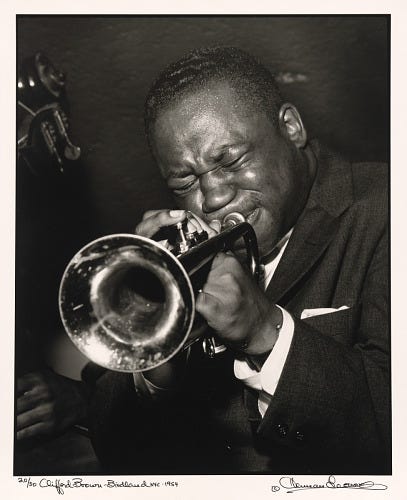
On this day 70 years ago, tragedy struck on the Pennsylvania Turnpike.
A car bearing trumpeter Clifford Brown and pianist Richie Powell lost control on a rain-slicked stretch of the highway near the Bedford Interchange, 200 miles east of Philadelphia. They were en route to Chicago, where the rest of the Clifford Brown-Max Roach Quintet was waiting; Powell’s young wife, Nancy, was behind the wheel, having taken over so the others could get some rest. She was 19 years old; Richie Powell and Clifford Brown were barely in their mid-20s. When the Buick struck a guardrail and then rolled down an embankment, all three were instantly killed.
I’ve thought a lot about that night, ever since I first learned about it.1 For WRTI, I just wrote a feature article that considers its repercussions, with a focus on Brownie. The piece runs just over 2,000 words, and I hope you’ll check it out. Part of what I set out to do is hopefully imagine an alternate timeline. But mostly what I did is consider real-world effects, including some that we typically take for granted.
My research involved an enjoyable second read of Nick Catalano’s 2001 biography2 as well as some new-to-me sources, like a 2011 essay in Black Music Research Journal.3 I also interviewed Sean Jones, who brought keen insights as a trumpeter, bandleader and educator; and Clifford Brown, Jr., a jazz radio veteran who was six months old when his father died. And I drew on past conversations I’d had with Sonny Rollins, who talked openly about how gutted he was by Brownie’s death.4
A few more strands of digression are worth sharing here. I’ll begin with the conviction that the Brown-Roach band was achieving new modes of liftoff in the weeks before that fateful crash. I didn’t feel comfortable sharing a bootleg on official channels, but I’ll submit it as evidence here. This was lifted from a radio broadcast at the Continental Restaurant in Norfolk, Virginia on June 18, 1956.
Just clock the tempo of that set-opening romp on “Just One of These Things” — it would seem ludicrous, if not for the ninja-like agility that Brown and Rollins both manage in their solos, and the stoic clarity that Roach, Powell and George Morrow bring to their pneumatic function as a rhythm section. Just unreal.
I’ll hasten to add that Brown was already scaring folks in this way a few years earlier, on A Night at Birdland with Art Blakey and the Jazz Messengers, and in other sideman appearances — like on the 10-inch Blue Note LP Jay Jay Johnson with Clifford Brown, which includes a Johnson tune whose title retroactively sends a shiver.
I’m sure you have your own go-to Clifford Brown recordings, and maybe some additional thoughts to share. I’d love to hear them, along with any feedback you have to the article. Here’s that link again.
Emmet Cohen on The Late Set
Earlier this week, WRTI dropped a new episode of The Late Set featuring pianist, bandleader, composer, and master convener Emmet Cohen. He had some astute things to say about cultivating an audience and tapping into the jazz tradition. I think a lot of folks, in and out of the tent, could benefit from hearing this.
You can listen as usual on Apple Podcasts or Spotify — and our team produced this one as a full video episode as well, which you can watch on our YouTube channel:
As usual, big ups to The Late Set producer Alex Ariff, who makes it all look easy. If you aren’t subscribed to the podcast, what’s stopping you? Our next episode will feature trombonist Kalia Vandever, from a recent conversation we had onstage at Solar Myth. Last night I did another of those with gayageum ace DoYeon Kim.
Fred Hersch Trio at The Village Vanguard
Last Thursday, I made a quick trip to New York for a Louis Armstrong House Museum gala honoring Wynton Marsalis. (More on that another time soon.) It was the day of the Knicks parade, which meant that a lot of folks in the streets and on the subway were still in their fan gear. The spirit was joyful and strong.
After the gala, I headed to the Vanguard for a late set by the Fred Hersch Trio, with Drew Gress on bass and Peter Erskine on drums. This was an unsurprisingly good decision. Hersch played a deeply lyrical and shrewdly calibrated set, mixing tunes by Kenny Wheeler and Antonio Carlos Jobim with a few of his own classics, like “Stuttering” and “Sarabande.” One of his encores was a Billy Joel tune, “And So It Goes,” which he prefaced with a dig at the NYT Mag’s 30 Songwriters list; the other encore was Leonard Bernstein’s “Somewhere,” which he prefaced by observing that “a lot of things are pretty fucked up right now,” so here was something hopeful.
I’ve seen Fred Hersch at the Vanguard more times than I can recall. But I couldn’t remember ever seeing Peter Erskine’s name on the calendar. As it turns out, this is because he hadn’t played the club in more than 40 years! His playing was marvelous, by which I mean I spent most of the set actually marveling at it. The care in his ride cymbal touch, which wouldn’t even warrant the technical term “attack.” The holistic energy of his time feel, which unexpectedly reminded me at times of Paul Motian (not that it sounded like Motian, just that it felt a bit like him, emotionally).
Erskine skedaddled before I had a chance to talk to him. But Hersch told me after the set that the gig he had more than 40 years ago was with John Abercrombie. Maybe it was even the one that yielded this rare video footage from the club, in 1985.
Anthony Braxton at Macdowell
Finally, a reminder: for the next few days I’ll be up in Peterborough, New Hampshire for Medal Day at Macdowell, honoring Anthony Braxton. If you’re anywhere in the area, please come out for an interview I’m doing with the Pulitzer Prize-winning composer Du Yun on Saturday afternoon in Historic Harrisville. (Register here.)
If you missed my recent post about Braxton at Macdowell, here it is again.
A Rare Honor for Anthony Braxton

The Edward MacDowell Medal, awarded each summer at MacDowell in Peterborough, New Hampshire, honors artists of exceptional achievement across a range of disciplines. Its first recipient was Thornton Wilder, who worked on Our Town during one of his MacDowell residencies. Since then the medal has been bestowed on the likes of Edgard Varèse, Georgia O’Keef…
I remember learning about “The Day the Music Died,” the 1959 plane crash that killed Buddy Holly, Richie Valens, and The Big Bopper. Each of my parents could vividly describe hearing that news, and how devastated they were as fans. This fatal car crash in ‘56 has always felt even more consequential to me, though I’d stop short of using Don McLean’s pithy phrase, because Brownie’s music didn’t die — a point I tried to articulate in my piece.
Nick Catalano, Clifford Brown: The Life and Art of the Legendary Jazz Trumpeter (2001, Oxford University Press).
Eddie S. Meadows, “Clifford Brown in Los Angeles,” Black Music Research Journal, Vol. 31, No. 1 (Spring 2011).
Rollins was also quoted to this effect in Aidan Levy’s magisterial Saxophone Colossus: The Life and Music of Sonny Rollins, another source I consulted for the article.
No surprise, Nate, your article on Clifford Brown is well-researched, thoughtful, and an excellent reminder of not only what the trumpeter brought to jazz but also how the musical form changed after his unfortunate passing.
Enjoy the event at MacDowell for Anthony Braxton. When he taught at Wesleyan, I used to see him around Middletown and, especially at concerts he created at the school's Center for the Arts. He was always friendly and would take time to talk. The honor is well-deserved.
Thanks for the lovely and thoughtful piece about Clifford Brown. Yes, so interesting to think what might have been, inclulding, say, a Clifford Brown-Sonny Rollins reunion along the way ...
Since you asked about favorites: Like Sean Jones, I'll take "Sonny Rollins Plus 4" as Brown's best recording in the studio. However, in a one-artist, one-solo challenge for Brownie, I'd take the epic ride on "A Night in Tunisia" from the famous jam session tapes from Music City in Philly that for a long time were thought to have been made the night he died but, per Catalano's Brown bio, we know took place on May 31, 1955. Everything great about Clifford Brown is in that solo -- the second bridge at 2:24! https://www.youtube.com/watch?v=U_SxclrGZ2w I also love his solo on "Brown Skins" with a big band in 1953 -- the song is a Quincy Jones original based on "Cherokee." https://www.youtube.com/watch?v=nLuXIwcAYGs
About a year ago, I became enamored with Clifford's solo on "Bellarosa" from 1953 -- so much so that I did a little transcribing and wrote it up:
--
"Was there ever a more perfect trumpet player than Clifford Brown? Listen to the golden lusciousness of his sound here, the clear-as-a-bell articulation, the graceful countenance of his swing, and the sheer melodic beauty of his improvisation. Details: The 6-½ bar snake he plays starting in bar 2 of the second A section is stunning – the witty bob-and-weave of the phrase, the rhythmic pirouettes, the surprising upward leap of a 4th to a high C going into bar 4. Then comes a truly startling jump of a major 6th to the high E-flat (the flat 9 of the D7 chord) in the midst of a clever turnback that gets back home by sliding down an arpeggiated augmented chord.
Perfection.
From Levy's Sonny Rollins bio, I learned that “Bellarosa” was written by Elmo Hope and Sonny Rollins when they were incarcerated at Rikers Island at the same time in 1952. The 1953 recording for Blue Note is still early for Brownie, and I'm struck by how the first 8 bars of the solo sound like his idol, Fats Navarro, especially the double-time. But the second 8 bars are totally mature Brownie, and those upward leaps into the balcony of the trumpet, especially the major 6th to the E-flat above the staff, foreshadow Booker Little. https://www.youtube.com/watch?v=v1R6a3Yg7BM&list=RDv1R6a3Yg7BM&start_radio=1
--
Coda: The footage of Brown on the Soupy Sales show actually dates to 1956. I interviewed Soupy about the discovery of the tape for the Detroit Free Press in 1996, not long after Soupy found it in his garage. I later fleshed out that piece for a chapter about Soupy for "Jazz from Detroit" but, alas, was forced to cut it at the last minute for space. As a heroic champion of jazz on his late-night show in Detroit in the '50s, Soupy was an important part of the ecosystem here.
Carry on.