
Tony Bennett at 100
The song that sums up the singer.

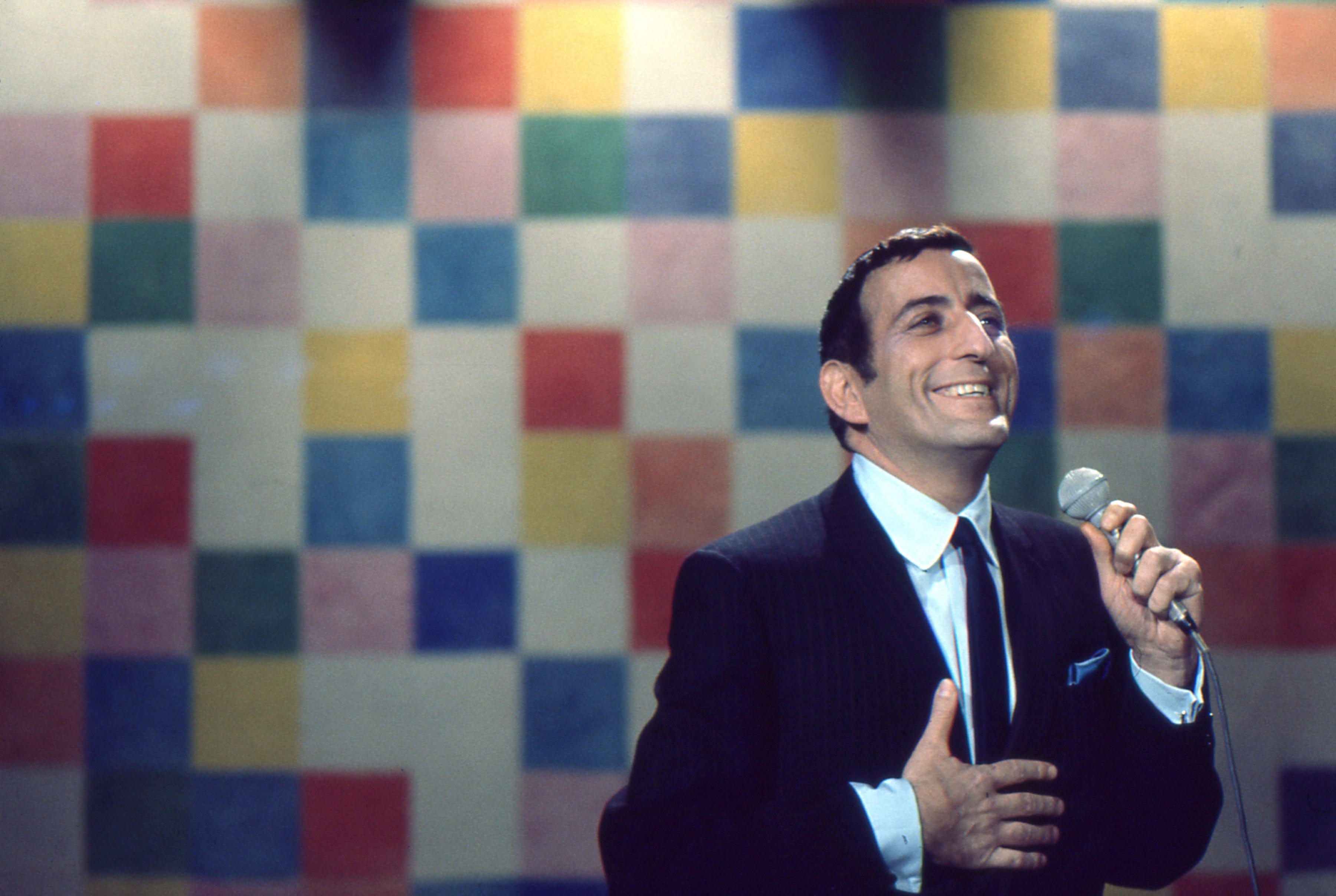
As this post sails out into the world, I’m heading up to Fort Adams State Park for the Newport Jazz Festival. More on that in a future dispatch, but if you happen to see me there, please say hello. In the meantime, I want to talk about Tony Bennett.
He was born a century ago this coming Monday, on August 3, 1926. Because I’m in a Newport state of mind, I’ll note that he made his first appearance at the festival precisely 60 years ago, turning up as a surprise guest with the Woody Herman Orchestra.1 A decade later he opened the Newport Jazz Festival - New York, co-headlining Carnegie Hall with the Bill Evans Trio.2
The last time Tony Bennett graced the Newport Jazz Festival, it was at Fort Adams in 2002. I wrote about that set, and shared a few personal stories, in the wake of Bennett’s death in 2023. The post says a lot of what I have to say about the man.
The Everyday Magic of Tony Bennett

So, which Tony Bennett album did you reach for when you heard the news? Or was it a video? A streaming playlist? Tell me where your compass led.
At this moment — as we observe a landmark, more than a loss — I have a few more thoughts to share. I’m focusing them on a single cut from across the expanse of Bennett’s recording career. And it isn’t some clever obscurity, pulled out of a dusty corner of the vault. I’m referring to a song that Bennett famously introduced, featured on a best-selling album, and kept singing for the rest of his life.
That album is I Left My Heart In San Francisco. Released on Columbia in 1962, it stayed a fixture on the Billboard 200 for many months, and was certified Gold after barely more than a year. It made Bennett a pop star, and a star persona: that fall, he sang the title song on NBC’s inaugural episode of The Tonight Show Starring Johnny Carson. The following spring, the same hit racked up hardware at the 5th GRAMMYs: Record of the Year; Best Background Arrangement; Best Solo Performance, Male.3
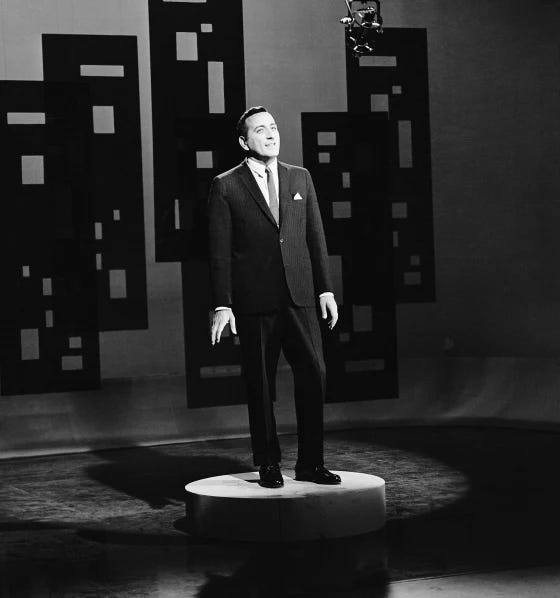
“(I Left My Heart) in San Francisco” is the first track on the album that bears its name, and fits every criteria I just named. But what I want to talk about the album’s final track, “The Best is Yet to Come.” To my ear, it’s the emblematic studio performance of this singer’s storied career. Please note that I’m not calling it “Tony Bennett’s greatest performance,” just the most Tony Bennett performance — the one that conveys the essentials of his artistry. His world in a grain of sourdough.4
Cy Coleman was the tune’s composer, and Carolyn Leigh its lyricist. Their other famous shared credit is “Witchcraft,” which I don’t think Bennett ever recorded, probably because he felt it was too firmly attached to Frank Sinatra. (More on that in a moment.) The song began as an instrumental that Coleman would play with his trio. “Carolyn Leigh heard it and wanted to write a lyric to it,” he recalled. “I told her that I didn’t think it would work as a song because singers wouldn’t take to the intervals.”
Bennett handles those intervals (and they are tricky, try singing them yourself) with the practiced ease I associate with Gene Kelly’s movements in an MGM musical. Part of that equation is insouciance: hear how Tony aims in the general area of a note, without worrying about precisely hitting the mark. Check the second four bars in the opening verse, where the lyric “You came along and everything started to hum” gives him an excuse to slur the intonation, as if he’s one Negroni past good judgment.
The song’s protagonist, in Bennett’s embodiment, gathers confidence as he goes. And confidence is all-important, considering that this is a sales pitch. “The best is yet to come, and won’t it be fine?” he beams. You picture him placing one hand on his prospective paramour’s arm, and using the other to indicate the horizon. And in Bennett’s Astoria patois, the pledge “You ain’t seen nothin’ yet!” carries a sympathetic vibration with the famous first line that Al Jolson delivered in a Hollywood talkie.
In the bridge, when this jazz singer negotiates “We’ve only tasted the wine / We’re gonna drain the cup dry,” he puts a little coarse-grain mustard on the word drain, as if singing it with a wink. And that amiably roguish charm extends to the final articulation of the theme, as Bennett laughs delightedly in the middle of the phrase. During the fade-out, another chuckle — ho-ho! — as if he can’t believe his good fortune, and yours too. This resolutely upbeat point of view, which Bennett expressed both literally and subtextually in various forms,5 is his bedrock. So, in a metatextual sense, “The Best is Yet to Come” suggests not only a romantic entreaty but also a philosophical conviction. No wonder it suits him like a bespoke dinner jacket.
As in so much of Bennett’s life and career, we find an instructive contrast with Frank Sinatra, whose version is the more famous by far. The Chairman recorded “The Best is Yet to Come” with the Count Basie Orchestra in 1964, for their second collab, It Might As Well Be Swing, with arrangements by a young Quincy Jones.6 Listen, and you gotta admit: Sinatra sings the hell out of the song — better than Tony, in technical terms.
But here’s the thing: each singer reveals himself in the singing. Sinatra, who famously dapped Bennett as “the best singer in the business,” delivers this message with the majestic poise of a royal. His offer of sensual bliss doesn’t carry the flicker of humility that Bennett’s does. And in our present cultural climate, I can’t help but feel a chill up my spine when Frank delivers the line: “Wait ‘til your charms are ripe for these arms to surround.”7 (Why doesn’t Tony trigger the same response?) Then there’s the ad-lib toward the end of the take: And you’re gonna be mine. For Sinatra, self-possession won’t suffice. He’s just as certain about the lands he’s determined to conquer.
Tony wasn’t a conquistador so much as a compadre, and he was as fully comfortable with this essential truth as he was with navigating a 32-bar form. This is one of the things that runs unwavering from his early work to the end of the road.8 To that end: below, you’ll find an edition of The Gig that I wrote in 2015, on the occasion of a late-career Bennett triumph. As for “The Best is Yet to Come” and peer comparison, let’s put it this way: Frank may have sung it better, but Tony sang it best.
The Timeless Tony Bennett, Then As Now
By Nate Chinen
Tony Bennett sings the title track of his new album, The Silver Lining: The Songs of Jerome Kern (RPM/Columbia), as a literal valediction, a parting word to the faithful. He’s accompanied on piano both by Bill Charlap, with whom he shares an artist credit for the album, and Renee Rosnes, Charlap’s partner by marriage. “Look For the Silver Lining” is the full name of the song, which they negotiate in an oratorial cadence, with softly glowing chords and a chromatic key change about halfway through. There’s a delicate improvised piano interlude, but the focus remains fixed on Bennett, who takes evident care in his enunciation of the lyrics, as if to lift them from idiomatic cliché into a realm of moral authority, or maybe just accumulated wisdom.
Bennett is now 89. He’s been a popular singer since the early 1950s, with some ups and downs, and a force in jazz for just as long. Over the last two decades, following a turn on MTV Unplugged that brought him back into mainstream circulation, he has been the perfect embodiment of an ongoing dialogue between jazz and classic pop: the grand old gent of the Great American Songbook, agreeably single-minded in purpose. His albums in this century have generally involved complex logistics and synergistic outreach, to fellow vocalists ranging from k.d. lang to B.B. King. With Duets II, released in 2011, Bennett became the oldest artist ever to top the Billboard album chart; last year he did it again with Cheek to Cheek, his marquee collaboration with Lady Gaga, which led to a barnstorming world tour.
I saw the first public performance by Bennett and Gaga, the same glittery concert later edited for broadcast by Great Performances, on PBS. We can debate the relative merits of Gaga’s jazz singing, as they say, some other time; what struck me in the moment was the gulf between her frantic showbiz heat and his courtly brand of cool. These two powerful singers were working across more than a 60-year age gap, in other words; they were expressing two ideals of performance almost diametrically opposed. That the allegiance worked (as I’d argue it mostly did) was testament to their unforced mutual regard, and to the sturdiness of the songbook itself. Still, watching the old romantic stoic beside the young volcanic trouper left a faintly discordant impression; it seems telling somehow that Lady Gaga’s next move wasn’t an album of any sort but rather a starring role on the surreally kinky FX series American Horror Story: Hotel.
By happy contrast, The Silver Lining represents both business-as-usual for Bennett and, poignantly, a reflection on his own musical past. It’s a low-muss, no-fuss production that could easily have been conceived as an antidote to recent spectacle, or at very least a recalibration. Bennett is far too circumspect a fellow to put it that way himself, but you can read between the lines of “I Won’t Dance.” As performed with Gaga, especially onstage, that tune was a boffo set piece, a charade of coy demurral. In the company of Charlap and his trio, with Peter Washington on bass and Kenny Washington (no relation) on drums, it glides along in waltz time, with a vocal delivery neat as a pocket square. This, Bennett seems to be implying, is how we roll.
The album is a bouquet of songs he has been finessing throughout his career, like “The Way You Look Tonight.” (He first recorded that in 1958 for his album Long Ago and Far Away, whose title track turns up here, too.) More significantly, this is the 40th anniversary of The Tony Bennett / Bill Evans Album, one of the most cherished titles in Bennett’s vast discography. So there’s resonance in his move toward a voice-and-piano format, despite the occasional assist from Rosnes or the rhythm section. Charlap even ventures what I presume is a deeply self-conscious emulation of Evans’ pianism, starting with the opening track, “All the Things You Are.”
The Complete Tony Bennett/Bill Evans Recordings, issued by Concord as a double CD in 2009 and a four-LP box this spring, is a vibrant reminder of how rare and sterling that partnership was. Comprising the first Bennett-Evans session in 1975 as well as a reunion the following year, which yielded the album Together Again, it’s a gemlike study in ballad singing and empathic accompaniment, with exceptional sound quality and a trove of alternate takes. Evans was a more florid stylist than Ralph Sharon, Bennett’s longtime pianist, but he adapted beautifully to the format. And it’s fascinating to consider the range of their repertoire, which ran from exalted fare to lesser fluff, with a few songs (notably Evans’ “Waltz for Debby”) becoming jazz-vocal standards only later, as a direct result.
That Bennett chose to focus his new album on a single composer is understandable — and hardly a restriction, given the quantity and quality of Kern’s output. What’s truly striking is the dauntless bounce in his phrasing, among the other ways he still sparkles as a vocalist. Age has constricted his range and brought a light rasp to his tone, but he has also made it a crucial facet of his artistry. To hear him sing “The Last Time I Saw Paris” or “Long Ago and Far Away” here is to consider the pain nestled deep within nostalgia. And this version of “Yesterdays” has the quietly riveting pathos of a monologue for the stage. Elsewhere Bennett devises workarounds: he’ll deliver one line with a chuckle, and another in a barker’s pitch, like Jimmy Durante. When he declares his love, on a song like “They Didn’t Believe Me,” there’s no room for doubt; like his old pal Frank Sinatra, Bennett makes his delivery feel like something other than a performance.
As I recently noted here, we’re living in a year of centennial tribute to Sinatra and Billie Holiday, whose vocal trademark may be the secret key to understanding Bennett’s. (He made an album called Tony Bennett on Holiday in 1997, but the best evidence I can offer is a track with Evans: “We’ll Be Together Again,” especially during the bridge.) It’s mind-boggling to consider that Bennett, a near-contemporary of both Holiday and Sinatra, is still making music that’s not only acceptable but compelling and vital. To that end, it’s fitting that the album wasn’t named “I’m Old Fashioned,” even if that track is a sauntering highlight, and its sentiment rings true.
“Remember: somewhere the sun is shining,” Bennett sings on “Look for the Silver Lining,” and his willful optimism, in the face of whatever darkness, feels as much like a behest as a gift.
According to a salty John S. Wilson, “Mr. Bennett, who can sing well with an easygoing, positive beat, put almost all of his effort into tempos so slow he could not sustain them, or so fast he could not keep up with them.” From the New York Times review (gift link).
This of course was on the heels of The Tony Bennett-Bill Evans Album, released the previous summer. “Tony may have done some of the best singing of his life on that album,” producer George Wein told the Times, when asked why Bennett had been chosen to open the fest.
Another, site-specific measure of the song’s legacy: in 2016, for Bennett’s 90th birthday, an eight-foot bronze statue of him was unveiled outside The Fairmount Hotel, where he first sang “(I Left My Heart) in San Francisco” in 1961, weeks before recording it in New York.
With deepest apologies to William Blake.
Consider another ur-text in the Tony Bennett catalog, “The Good Life,” which he borrowed for the title of his 1998 autobiography. Later in life, he published another memoir titled Life is a Gift.
Yes, I know: this lyric was penned by a woman. That doesn’t change the point here.
If you desire proof, I’ll steer you to this staged production of “The Best is Yet to Come” from 2013, when Tony was singing it as a duet with Diana Krall. The dancers, the set, all of it feels desperate for your approval. But not Bennett: he’s just singing the tune.
thanks nate, i love when people love tony, and I think insouciance is indeed the best word to capture his essence.
I find Sachal Vasandani to be the most representative of that essence in male jazz singers today. not that he's a copy of Tony, just that he is calmly comfortable in any musical situation. he doesn't take over, he just sings like he understands the words.
Great job. Hope to see you at Newport.