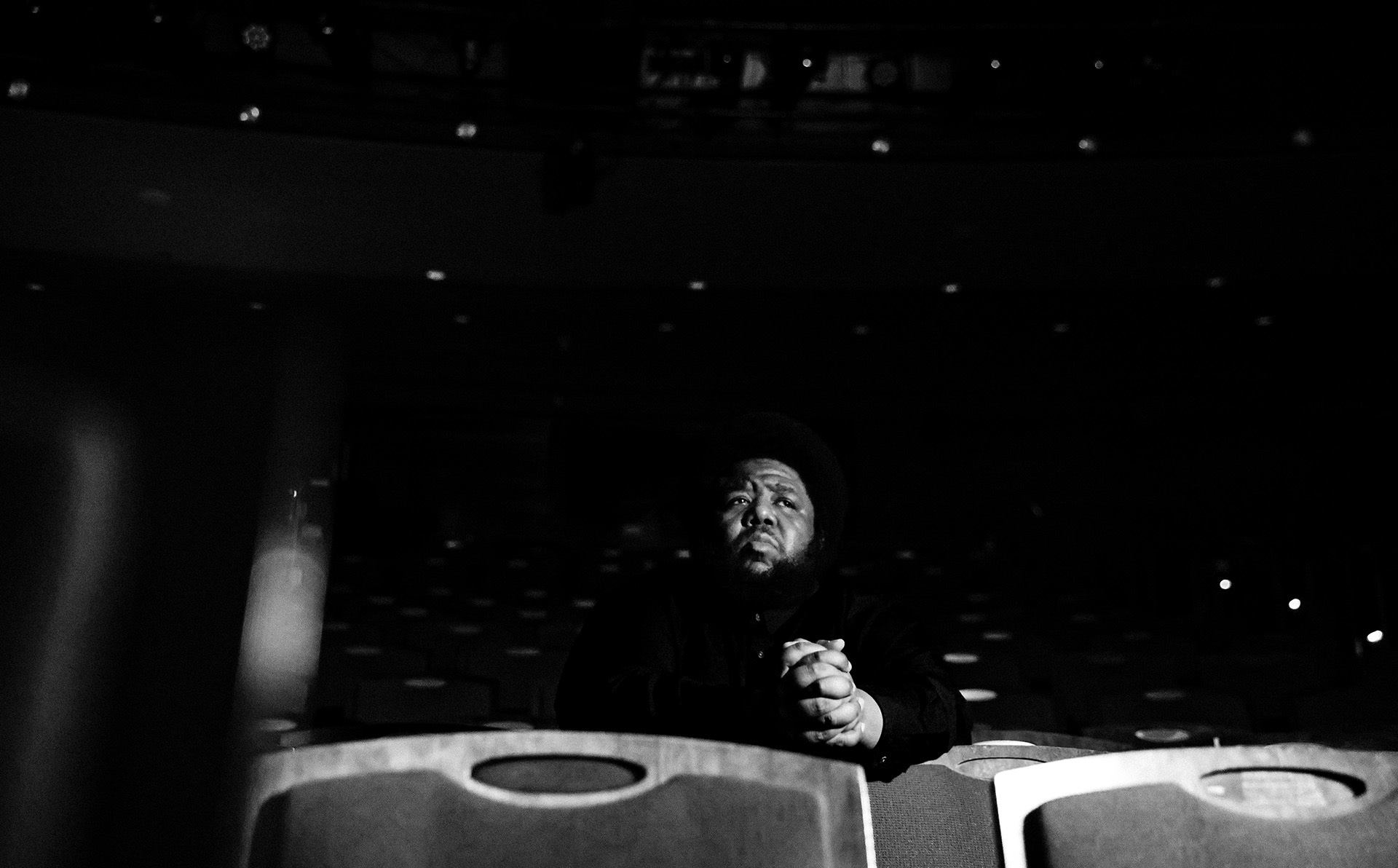
Abstrusions + Absolutions
Tyshawn Sorey's 'Members... Don't!' and 'Monochromatic Light (Afterlife)'
Six weeks ago, I experienced a concert that basically blew my mind.
It was Tyshawn Sorey’s reinterpretation of the landmark 1968 Max Roach album Members, Don’t Git Weary. Originally presented a couple of years ago at the Winter Jazzfest on Max’s centennial, the project has deepened and ripened since.
What I caught on February 6, courtesy of Penn Live Arts, was its latest incarnation. Along with Sorey on drums, it has Adam O’Farrill on trumpet, Mark Shim on tenor saxophone, Lex Korten on piano and Tyrone Allen II on bass. Fay Victor also swoops in as a powerful late-inning closer. The performance sprawled across about 100 minutes, unfurling as a seamless canvas. I’m not exaggerating when I say that in some inarticulable way, it left me changed.
The next morning, I met Tyshawn at a coffee shop near his home in a Philadelphia suburb. He was suffering through a cold, but graciously kept our scheduled interview, and talked in considerable detail about Members, Don’t Git Weary as a guidepost, a springboard, and an admonitory challenge. He also revealed a piece of exciting news: the upcoming release of this material. That double album — bearing the literally elliptical title Members… Don’t! — will be released on Pi Recordings on May 29.
I had the privilege of writing the liner notes for this extraordinary release, which was recorded on the final night of a four-night run at The Jazz Gallery last June. Considering the due acclaim that greeted each Pi release by the Tyshawn Sorey Trio, as well as The Off-Off Broadway Guide to Synergism with Greg Osby, I feel secure in predicting that for those of us who care about creative music, this will be one of the most galvanizing releases of the year.
The Members project represents many things for Sorey: a love offering to a heroic predecessor; a charged interaction with “the jazz tradition,” scare quotes and all; a disquisition on long-form, quick-change orchestration; a pointed engagement with cultural and political realities that reverberate darkly from Max’s time to our own. One thing that it doesn’t represent is a retracing of the outline. That’s a strategy all too familiar in jazz — here I refer you to the latest Coltrane celebration — but confoundingly foreign to the aesthetic principles that Sorey holds dear.
Because I want you to hear the album, and read my notes in that proper context, I won’t say much now about the way that Members… Don’t! is organized and executed. But I will share two bits of behind-the-scenes intel that you won’t find elsewhere.
The first involves a moment that I witnessed during the performance in Philly. At one point, as a bridge between Stanley Cowell’s “Effi” and Jymie Merritt’s “Absolutions,” Korten was given an open space to elaborate. He conjured a shimmer of sound from the piano, translucent and delicate as a pane of spun glass. It was exquisite, but after a minute or two, I began to wonder where it was headed. Sorey, who had spent that minute or two picking at one of his drumsticks, provided the answer when he tossed the stick over his shoulder, and it hit the stage with an unceremonious clatter. Trance broken, Korten looked over at him, and Tyshawn nodded vigorously: good good, sounding great, now let’s go. In my seat, I laughed out loud in appreciation.
“It was a musical gesture,” Tyshawn confirmed, also laughing, when I asked him about this disruption, “as well as: ‘let’s get this thing moving.’ It was my way of dialoguing with him at that time. Like what Charles Mingus and Danny Richmond would do — you know, how they would talk to each other in quotes.”
The second piece of intel has to do with Cowell’s elegant “Equipoise,” which serves a pivotal role in the Sorey conception of Members.1 I noticed this during the concert, and asked him about it over coffee: “Can you speak to why that piece is where it is, and why it functions the way it does?”
I was taken aback when Sorey replied by recalling something I wrote for the New York Times Jazz Listings more than a decade ago: “Tyshawn Sorey can play the drums not only with gale-force physicality, but also a sense of scale and equipoise.” It was a sentence that resurfaced for him when he approached “Equipoise” as a source text. “So when I thought of that statement, I said, ‘Well, why not make that the pivotal point of what’s going on in the music? Let me find a way to extend this, through a wider scale.’ Rather than playing the melody and then solos and then melody out, maybe we can reframe it in a number of different ways, and have the piano solo be the defining moment where the energy of everything in the suite starts to shift.”
Again: Members… Don’t! will be available on Pi Recordings on May 29. And as you may be aware, it isn’t the only notable new release by Sorey this year.

The other release I’m referring to is Monochromatic Light (Afterlife), a gemlike studio recording of the piece that Sorey presented first at the Rothko Chapel in Houston, then at the Park Avenue Armory in New York, and in several other settings since. It’s the inaugural release on DACAMERA Editions, which spared no expense in creating an objet d’art, complete with brilliantly insightful liner notes from Sarah Rothenberg — who, as artistic director of DACAMERA, co-commissioned the work.2
When Monochromatic Light (Afterlife) was staged at the Park Avenue Armory, I spent a day observing rehearsals, before attending a performance. In a side parlor at the Armory, I sat for a conversation with Sorey, bass-baritone Davóne Tines, and visual artist Julie Mehretu. I walked around the space with director Peter Sellars, and talked briefly on site with choreographer Reggie “Regg Roc” Gray.
Subsequent phone interviews with Rothenberg and percussionist Steven Schick provided further insight for a feature at NPR Music. Rereading it now, I feel it captures the sensation and intention around the New York staging, which isn’t precisely the same as what we encounter on the studio recording.

Sorey was an artist in residence last year at Big Ears, where Monochromatic Light (Afterlife) was performed in a cathedral setting, with no graphic or choreographic complement. I regret not hearing the piece in this austere presentation, because the music rewards focused listening. The new album helped me to understand that, in a more tactile way. Talking it over with Tyshawn helped, too.
Here below is an illuminating exchange:
Chinen: The piece has a lot of very small gestures, and the grandeur is deep inside the gesture. You know, Sarah plays a chord, or, or Steve plays a chord on the vibraphone. And inside that chord, there’s one note that is held.
Sorey: Yeah.
That one little thing, which I’m sure is notated and very specific, it’s a tiny little detail. And if you’re attuned to notice it, it’s mind-blowing, you know?
Right.
It can be hard for that to stand out when you’ve got so much else going on.
Yeah. Right, right.
So that was my feeling about it. I really understand why this needs to be presented in this way. You know, Kim Kashkashian’s resonance…
Yeah.
…the way that she can make a note just bloom and sing.
And the way that she carries that piece. You know, from start to finish, it’s a heavy responsibility for Kim, for 75 minutes or whatever, to carry that piece on the viola. I don’t know what an average listener is, but for a civilian, you actually can notice something like that if you’re really called to a meditative space.
Right.
And that’s what the Rothko Chapel is. It’s a space that encourages that kind of attention to detail.
I think the album does now, too.
Thank you. I thought of Members in the same way. It’s another form of meditation.
So let’s talk about the parallel between Members and its relationship to Max Roach, and Monochromatic Light and its relationship to both Rothko and Morton Feldman.
Yeah.
We just observed Feldman’s centennial. How does he live in your piece?
There’s an intellectual relationship with both Rothko and Feldman in that the thing I took away from both of those two was that… Well, I’ll just talk about Rothko for a minute. His paintings, he wasn’t necessarily interested in entertaining the viewer, right? I mean, the thing he wanted to reflect in his paintings were a lot of tangible and intangible things as related to trauma, as related to grief, as related to history — person’s history, where they come from, who they are. It wasn’t really about the external things that he was interested in expressing in his paintings. And I found that to be the case for Feldman as well. Listening to his Rothko Chapel, where all of these things are in play with each other, like lineage and history, you could hear the reflection of all of these different feelings and emotions. So I guess the connection for me was that it’s the same type of same emotions I’m dealing with in Monochromatic Light, but I’m dealing with that both from an internal and an external point of view.
Mmhmm.
When you’re looking at the paintings for an extended period of time, and how they change — how those black paintings change color from the sunlight, or the skylight that’s in the chapel. How that changes the viewer’s perception of the paintings. That’s one factor that contributed to the temporal aspect of the piece, and why it is longer than Feldman’s Rothko Chapel piece.
Yeah.
It’s the same thing with Members, Don’t Git Weary and why these two things belong in the same discussion. I mean, 1968, right? Think of what was going on that year. Max Roach, by that point, was heavily vocal about a lot of the activity that was going on, even well before that. I’m listening also to the sonic energy of that album. It’s in your face. It’s heavily charged. It’s expressing emotions, it’s expressing the turmoil, it’s expressing a lot of the different internal intangibles that have plagued Black America, and that plagued America in general. You look at the murder of Robert Kennedy, the murder of Dr. Martin Luther King. You’ve got all of the protests happening in the United States. I mean, there’s so much going on in ‘68, and it was a hot summer, you know, when they were getting this record together.
There’s a crucial space for a spiritual in Members, as there is in Monochromatic.
In the latter, it’s Davóne Tines booming “Sometimes I Feel Like a Motherless Child,” and in the former it’s Fay Victor deconstructing “Keep Your Lamps Trimmed and Burning” (which on Max’s album is reframed and reclaimed as the title track). It’s one way in which Sorey dialogues with the tradition of Black American expression, even as he imagines something more capacious than any national or historical frame.
In the liner notes, I quoted an observation that Tyshawn made about the conceptual link between these two outwardly contrasting musical statements. Reading a draft of the notes, he made a clarifying edit, and I think it’s worth including here. It feels fitting, in this instance, to give the composer the final word.
“Among many aspects we can discuss, temporality is one of the biggest things that I aim for in my work,” Sorey said. “The way that we perceive music over long periods of time — by way of extended through-composed forms, spontaneity in ensemble approach and other means — is what I always try to bring into focus. What I’m after is having the listener take their time, slow down, listen to the bigger picture and take a broader look at things.”
In addition to its placement on Members, Don’t Git Weary, “Equipoise” is a highlight of Stanley Cowell’s 1973 solo LP Musa: Ancestral Streams. I wrote the liner notes for a recent Strata-East / Mack Avenue reissue of that album; you can read them here.
DACAMERA announced this week that its second release will be a Sarah Rothenberg recording, In Darkness and Light, with themes by Beethoven, Morton Feldman, and Vijay Iyer. I wrote about this recital, focusing on Iyer’s contribution, in a piece for WRTI in 2022.


I was lucky enough to be in the audience when Tyshawn Sorey presented his Master's Thesis concert at Wesleyan University. It was a long and varied program with several nods to Morton Feldman, especially later in the program. Reading about "Monochromatic Light", I am reminded of that performance. It's when I first understood "gestural music". And realized that was part of most "genres" of music, even popular music. Excellent article as always, Nate––I look forward to "Members....."
I can't tell you how excited I am to know Tyshawn Sorey's "Members... Don't!" releases in May. Suffice to say that I've become somewhat obsessed with the song "Equipoise" ever since I heard it on the "Musa - Ancestral Streams" album (big thank you for making me aware of this record). When I read the Jason Moran quote, I didn't even both going through my normal process of first checking it out before buying the CD (still a small way of better compensating the artist than streaming everything). "Equipoise" is brilliant in every way. Searching out other versions of it led me to the Max Roach album, with which, I'm embarrassed to say, I was unfamiliar. Unreal. Just unreal.
Fyi, "The Willie Jones III Sextet Plays the Max Roach Songbook" is a wonderful record with a great version of "Equipoise" (Eric Reed's on piano).
And, a final thought. I had a long running joke with Randall Kline where whenever I'd see him in the lobby or something at SFJazz I'd say some form of Thank You followed by, "Now, when are you going to book Kamasi Washington here again?!" With you, Nate, it's going to be, "When are you going to review Jorge Luis Pacheco's "live from HAVANA" album?!"